
Weekly News | August 7 2026

Matthew Jukes passes away:
The wine trade sadly lost one its most influential figures yesterday (Thursday 6 August).
Over a career spanning almost four decades, he authored 14 books, created a series of influential annual reports including his renowned 100 Best Australian Wines, judged at leading international wine competitions, and hosted masterclasses and wine events around the world. He was also widely recognised as one of the UK's foremost authorities on Australian wine, receiving the Honorary Australian of the Year award in 2012 for his contribution to promoting Australian wine.
Some of his most recognised journalistic work includes 22 years at the Daily Mail and more recently his weekly column for Money Week while also updating his own website.
Beyond his writing, Jukes was admired for making wine more accessible to consumers while championing producers and regions across the world. His influence extended well beyond journalism, helping shape the way countless wine professionals and enthusiasts discovered and appreciated wine.
He will be hugely missed across the global wine community, and our thoughts are with his family and friends.
Louis Roederer makes a move into Burgundy:
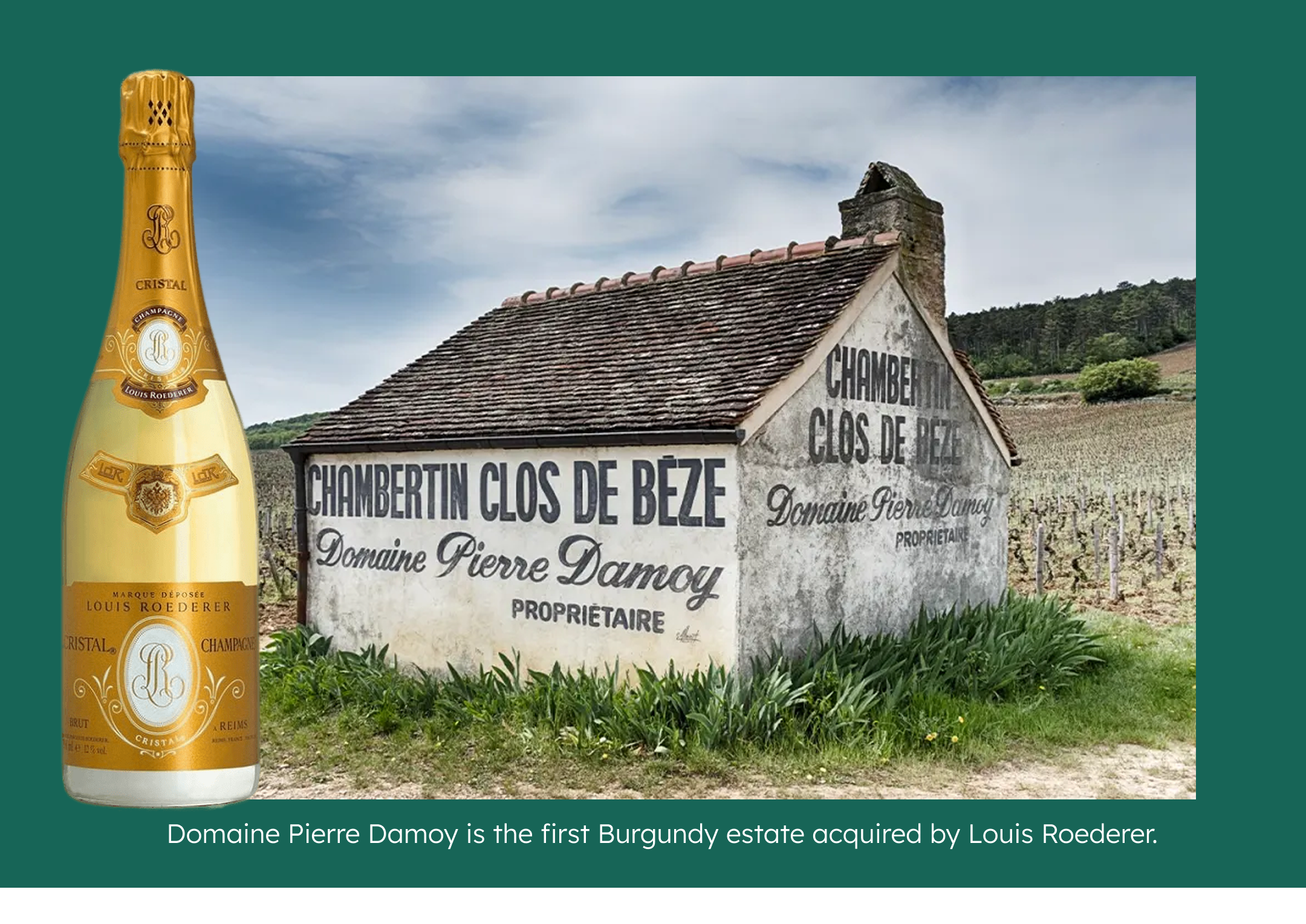
In Burgundy, bottles are traded every day. Vineyards are not. It is no surprise therefore that the recent acquisition of Domaine Pierre Damoy by Louis Roederer has made headlines.
Most notably due the rarity of an estate of this scale becoming available in Burgundy, where ownership of top vineyard land is highly fragmented and properties seldom come onto the market.
Louis Roederer, who are perhaps most well known for their iconic Champagne Cristal, now owns nearly eight hectares of grand cru vineyards, primarily in Chambertin, Chambertin-Clos de Bèze and Chapelle-Chambertin, three of Gevrey-Chambertin’s most prestigious appellations. They will also own Clos Tamisot, a Gevrey-Chambertin monopole, meaning the vineyard is controlled by a single producer.
Domaine Pierre Damoy is now housed under the champagne company’s ‘Roederer Collection’, which includes 12 wine brands from France, Portugal and the US.
Louis Roederer CEO Frédéric Rouzaud commented on the deal that, ‘In the year Louis Roederer celebrates its 250th anniversary, establishing a presence in Burgundy, one of the world’s most prestigious wine regions, and becoming the steward of one of its great estates carries a special meaning for us.’
Burgundy has never been a region driven by expansion. Instead, its reputation has been built on centuries of stewardship, family ownership and an unwavering commitment to quality. That is precisely why acquisitions such as Louis Roederer's are so significant. They are not just business decisions, but milestones in the history of one of the world's most revered wine regions.
For wine collectors, wine merchants and industry professionals alike, these rare transactions reaffirm Burgundy's position at the pinnacle of the global luxury wine market.
Bibi Graetz walks away from La Place de Bordeaux:
La Place de Bordeaux is the world's oldest and arguably most influential fine wine distribution network. Traditionally, La Place existed solely to sell Bordeaux wines, and every spring, the system comes to life for the Bordeaux en primeur campaign, when merchants buy wines before they are bottled.
However, La Place has evolved over the past twenty years into a global luxury wine marketplace where other countries now sell their flagship wines through the same network in the annual ‘Beyond Bordeaux’ campaign each September.
Names like Ornellaia and Masseto in Italy and Opus One and Joseph Phelps Insignia in California, effectively a who's who of the world's blue-chip wines. So why would a winery leave the system?
As some background, the Graetz family were artists who happen to own some vineyards overlooking Florence where the grapes were made into wine for the table. It wasn’t until 2000 that Bibi Graetz formally began treating the vineyards seriously, and released the estate’s first commercial vintage which quickly attracted attention from wine critics and collectors.
Once inside the La Place system it achieved what it was designed to do and gave a relatively young Italian estate immediate access to the world’s most important fine wine markets. It became a launchpad, placing Testamatta and Colore alongside the world’s elite names and helping establish Graetz as a serious luxury wine brand.
Graetz’s justification for the brand's departure is that La Place excels at opening doors and expanding reach, but that luxury wine ultimately depends on scarcity, consistency and careful market management. When a brand grows rapidly, the priority shifts: it is no longer only about finding buyers; it is about protecting perception, pricing and collector confidence.
Now Bibi Graetz is quietly rebuilding and prioritising depth. Fewer distributors and more margin for his partners to actually invest in the brand. The UK is the winery’s single largest market.
Bibi Graetz’s departure is not the end of La Place de Bordeaux. The system remains one of the most powerful distribution networks in the fine wine market, and many of the world’s most prestigious estates continue to rely on it. But it does raise a more uncomfortable question which is once a brand has achieved global recognition, does it still need La Place or does it need something else?
.png)