Wine News | Week 1 October 2026

Singapore Wine Week 2026:
This week saw the inaugural Singapore Wine Week 2026 which underlines Singapore’s growing role as a fine-wine hub in Southeast Asia. The event brought together producers, collectors, sommeliers and the general wine trade. The wider market is supported by a sophisticated consumer base, strong luxury hospitality and Singapore’s position as a regional gateway for premium wine.
67 Pall Mall Singapore is a good illustration of this growth: its 2022 opening brought the London-based private wine-club model to Asia, with around 6,000 wines and 1,000 available by the glass. Its presence reinforces Singapore’s emergence as a serious destination for fine-wine consumption, discovery and community.
In short, Singapore is increasingly relevant to the global fine-wine market, not just as a place to sell wine to, but as a regional centre for collectors, hospitality and wine experiences.
Michael Burry's Big Short:
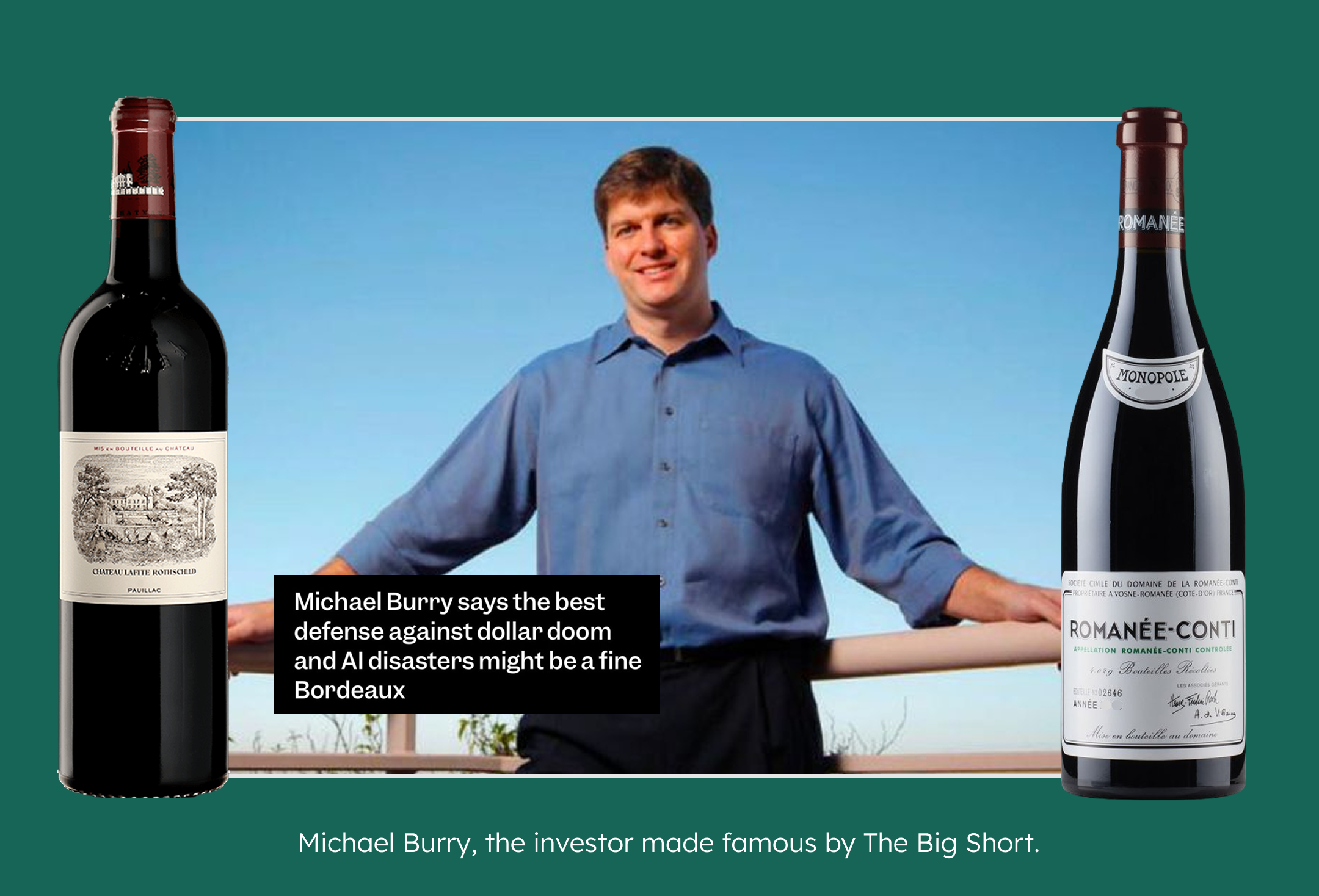
The fine wine market received an endorsement a couple of weeks ago from renowned American investor and hedge fund manager Michael Burry, known to many through the movie, The Big Short, who wrote the following on his Substack, ‘just about every single case of fine wine sitting in a London bonded warehouse can be a short position on the US dollar, a global hedge against fiat currency, and a ward against global financial systems' vulnerability to the various hellscapes possibly wrought by future iterations of AI and quantum computing.’
Burry evaluated about 700 wines, of which he bought 40. Targeting the most liquid names, so first-growth Bordeaux including Pétrus, Margaux and Mouton Rothschild, plus blue-chip Burgundy’s and Champagne. Labels which trade actively on the secondary market through platforms like Vinimo. In a world where AI and quantum computing seem to be taking over, Burry argues for redirecting capital toward physical stores of value that computers cannot delete or devalue overnight.
He also adds the supply argument, something wine investment firms are very fond of and which is unique to wine unlike other asset classes like gold, art and watches. Every bottle that is enjoyed permanently removes that specific vintage from the tradable market. He projected that by buying at today's discounted prices, an investor could make four to five times their money over the next 20 years as a weaker dollar compounds the return.
The Angel Investor Network had numerous good points to counter the above. Their first point being that prices have fallen hard from the speculative froth of 2021-2022. The more relevant question is whether the drawdown is finished.
The most interesting part of the Angel Investors Network report that stood out was the liquidity reality of fine wine. Unlike traditional financial assets, fine wine has no neutral exchange or continuous market price, and the costs of buying, storing and ultimately selling can be significant.
Headline returns can be misleading when you factor in mark-ups, storage, insurance and selling commissions. A buyer therefore needs to see meaningful appreciation in the underlying wine price just to break even. This is particularly relevant when comparing different routes to market, traditional merchants can charge +10% on sales, while some investment-led models can charge 15% or more for management and disposal over a 5 year period. By comparison, platforms such as Vinimo aim to make pricing more transparent and offer a lower-cost approach to accessing and exiting the market which can materially change the economics for wine collectors.
Only time will tell if Mr Burry is right again.
Dom Pérignon 2018 gets creative with Damien Hirst:
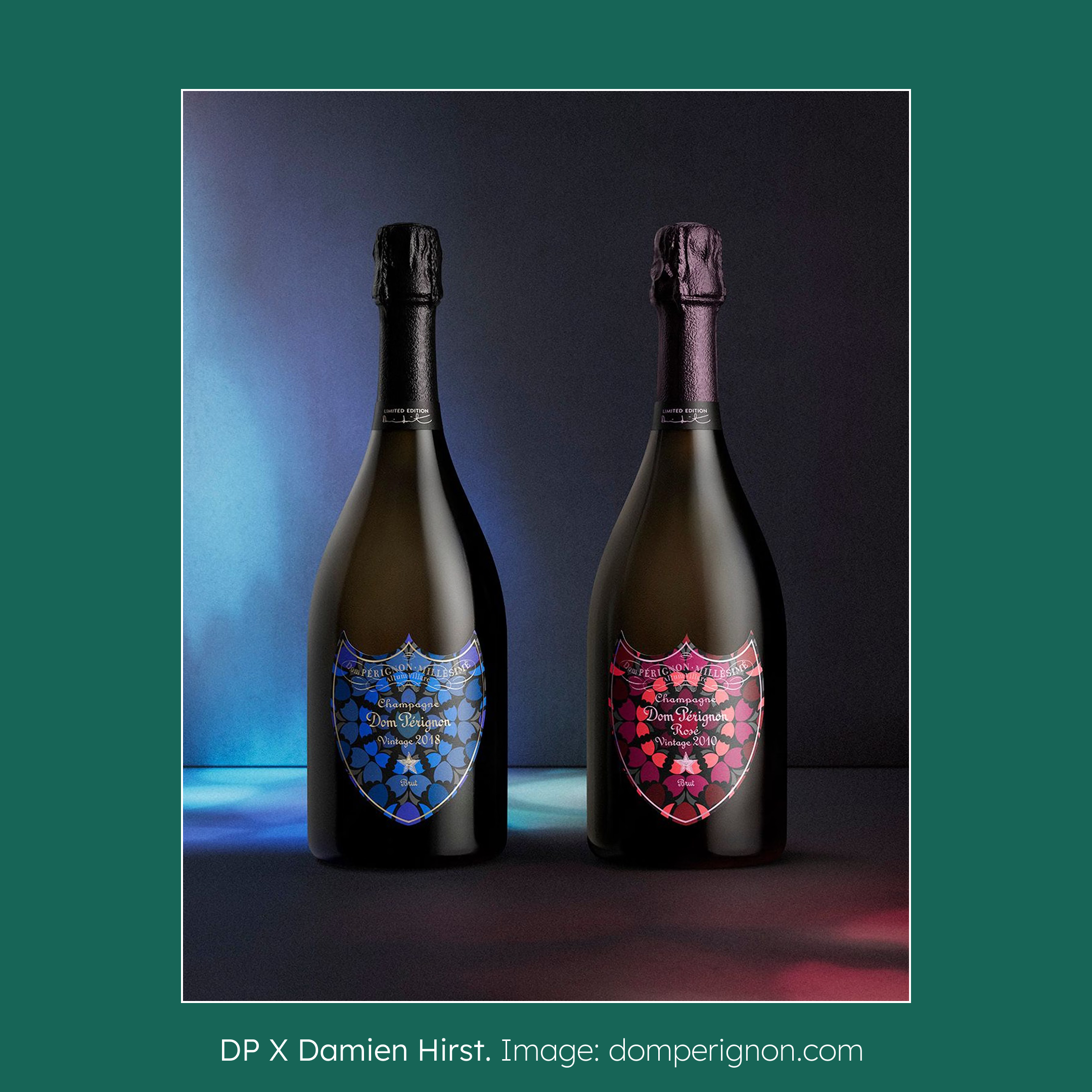
Off the back of the release of the 2018 vintage of Champagne Dom Pérignon, which came to the market at £798 per 6 x 75cl in bond, the LVMH owned Champagne house has announced it’s end-of-year limited edition Champagne, created in collaboration with British contemporary artist Damien Hirst.
It’s not the first time DP has worked with a renowned artist. In 2005 it started working with Karl Lagerfeld and later took in the musicians Lenny Kravitz and Lady Gaga.
The latest collaboration see’s Hirst take inspiration from his Kaleidoscope paintings and reworking the champagne house’s historic shield into a repeating kaleidoscopic pattern in which the emblem ‘does not disappear’ but ‘multiplies through the composition’, according to the LVMH. A deep blue marks Dom Pérignon Vintage 2018 and a ‘warm and gentle pink’ marks Rosé Vintage 2010, a nod to the Pinot Noir at the heart of the rosé.
Against current market price, a case of the 2018 vintage looks quite reasonable with the 2017 sitting at around £811 and 2012 at £855.
The 2018 therefore looks competitively priced within the current Dom Pérignon market. The new release is only modestly cheaper than vintages like 2012 that have had considerably longer to mature. For collectors, that makes 2018 an interesting entry point. It is not obviously discounted, but neither does it appear to carry a meaningful new-release premium relative to comparable vintages.